|
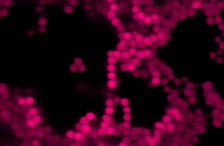
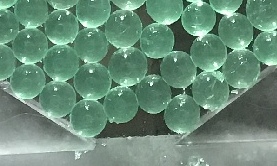
Suspensions of densely packed colloidal particles are a
simple model system which exhibits a glass transition, as the
concentration of the particles is increased. We use confocal
microscopy to look at the particles and determine how their
motion changes as the glass transition occurs. We study these
materials in situations including flow through tubes and being
poked with tiny magnetic beads. These experiments give us
insights into the glass transition in a fashion impossible
for regular glasses.
We also study the properties of other complex materials, including foams and sand. See below for information about our various projects. |
|
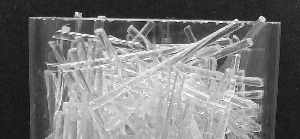
![]() Diffusing rods We look at the Brownian motion of rods tumbling and drifting in 3D. What does their motion tell us about the viscoelastic properties of their medium? |
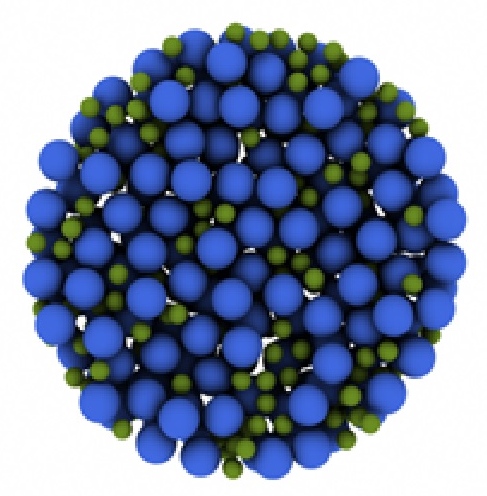
![]() Confinement and the glass transition The glass transition is modified in confined spaces, but it's unclear why. We're studying colloidal particles confined between two parallel walls; we find their motion slows down. |
![]() Aging of colloidal glasses |
![]() Tetrahedral structure in aging colloids As colloidal glasses age, does their structure change? We find not, but that the local structure is correlated with the dynamics of the particles. |
![]() Microrheology of interfaces |
![]() Microscopic behavior of flowing colloids We're studying the behavior of colloids as they flow through tiny tubes. As they flow faster, the apparent viscosity decreases. What is the microscopic behavior responsible for this? |
![]() Emulsion glasses We visualize how droplets deform in a concentrated emulsion. In some circumstances emulsions can act like a glass, and studying the deformed droplet shapes should help us understand the emulsion glass transition. |
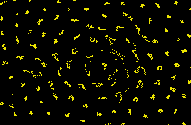
![]() Poking colloids with magnets We put small magnetic beads into colloidal glasses and pull on them with really strong neodymium magnets. How does this disturb the particles? |
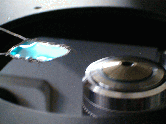
![]() Structure of colloidal gels We're studying the structure and dynamics of colloidal gels. How does the gel change when we vary the stickiness of the particles? |
|
| |
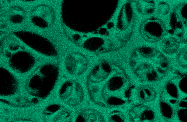
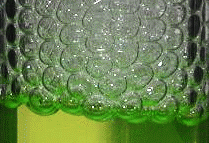
| Draining water from foam: As water flows between bubbles in a foam, does it flow like regular flow through a pipe? We found that it depends on the type of soap used to make the foam. Work done in collaboration with Stephan Koehler. |
FUNDING:
Any opinions, findings, and conclusions or recommendations
expressed in this website are those of the author(s) and do not
necessarily reflect the views of the National Science Foundation.
Nor anybody else's views, for that matter, just us.