|
<dr^2> = 4D dt D = kT *(complicated logarithmic correction)/ (4 pi eta_s ) |
The coupling between the interface and the bulk fluid reservoirs also causes the two-particle correlations to be modified from the 1/R behavior described in the previous section. While this has been described by theory, no experiments to date have performed 2-particle microrheology at an interface. We look at the correlated motion of polystyrene beads at an air-water interface inhabited by Human Serum Albumin (HSA) molecules. We find that the correlated motion depends sensitively on the surface viscosity eta_s of the interface. Details about this behavior can be found in our paper:
- "Two-particle microrheology of quasi-2D viscous
systems"
V Prasad, SA Koehler, ER Weeks, Phys. Rev. Lett. 97, 176001 (2006).
Microrheology of soap films
A soap film is truly a quasi 2-d viscous system, since it consists of an extremely thin layer of water, and two surfactant layers that buffer the water from the air above and below it. The thickness of the soap film can range from a couple of nanometers to many microns thick, but if it reflects light in the optical spectrum, then the size is probably beween 100nm-5 microns. Shown below is a picture that is taken of an 18-hr old soap film (I made it with a solution of 60% glycerol, 40% water and 2% solution of the kitchen detergent DAWN)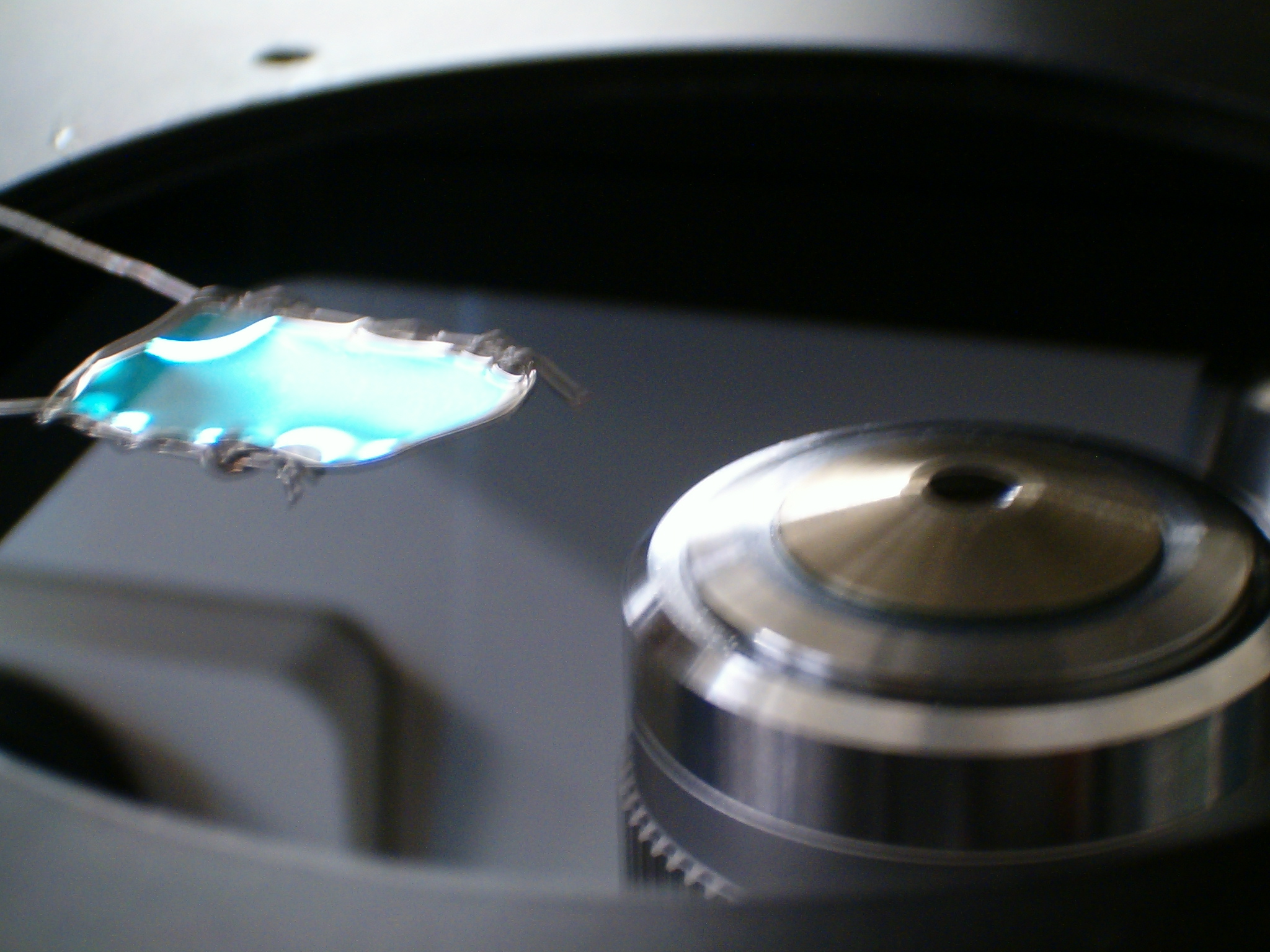
Since the soap film looks lightish-blue in color, it is of the order of a few hundred nanometers. Typically, the soap film starts off as micron-sized or slightly larger, but over time it drains of water, and starts thinning. Experiments are in progress to entrain spheres (colloids) and rods (bacteria) in these soap films and to observe their Brownian motion.
Soap films are extremely thin, but our work shows that in some cases three dimensional effects due to their finite thickness are important. When the soap films are really thin (less than a micron thick), they behave as 2D liquids with a 2D viscosity. However, clearly this will not be true if the layer of liquid is extremely thick; in such a case you'd have to see 3D liquid behavior. In our work, we identify precisely where the transition from 2D to 3D behavior occurs as the thickness of the soap film is gradually increased. We do so by putting spherical particles of size d in soap films of thickness h, and observing the thermal Brownian motion of these particles with a microscope. This is done for different values of h/d ranging from 0.5-15. We use the particles' motion to measure a 2D viscosity of the soap films. Unphysical values of the 2D viscosity are found for soap films with h/d > 7, leading us to propose that soap films transition from 2D to 3D fluid-like behavior at a critical ratio h/d = 7. Details about this can be found in our papers:
- "2D to 3D transition in soap films demonstrated by
microrheology"
V Prasad & ER Weeks, Phys. Rev. Lett. 102, 178302 (2009)- Abstract / PDF / citeulike / arXiv:0807.4751 / journal
- "Flow fields in soap
films: Relating surface viscosity with film
thickness"
V Prasad & ER Weeks, Phys. Rev. E 80, 026309 (2009)- Abstract / PDF / citeulike / arXiv:0905.1435 / journal
- "Measuring and overcoming limits of the
Saffman-Delbruck model for soap film viscosities"
S Vivek and ER Weeks, PLoS ONE 10, e0121981 (2015).
For more information, please contact Eric Weeks: <weeks(at)physics.emory.edu> or Vikram Prasad: <vprasad(at)physics.emory.edu>